Long Island Buddhism listing
of spiritual Buddhist temples and
meditation events on Long Island. Are you a Long Island Buddhists?
Are you looking to have spiritual fellowship with fellow Buddhists?
Check out
Long Island Meditation
events. Long
Island Browser spirituality and religion section
providing listing of Buddhism, Buddhist temples,
Buddhist faith, Buddhist priests, Long Island Religion,
Long Island Spirituality, Long Island Faiths Practices,
Long Island New York, Nassau County, Suffolk County, Hamptons, North Shore, South Shore, North Fork, South
Fork.
|
|
|
|
|
|
Long Island Buddhist Resources |
 |
 Long Island Buddhist Meditation Center
Long Island Buddhist Meditation Center is located in
Port Jefferson, Suffolk County, Long Island, New York established in
2008 on a property donated by Mr. Don L. Jayamaha and
Dr. Sharmini Jayamaha. The meditation conducted in these
premises is being used both for the purpose of enhancing
our spiritual values as well as for providing an
opportunity for others with parallel aims and leanings.
Long Island Buddhist Meditation Center has been
designated as a tax exempt, publicly supported,
charitable organization under section 501 (c) 3 of the
Internal Revenue Code and all donations are fully tax
deductible. Federal Tax ID# 80-0148046.
Long Island Buddhist Meditation Center
5 Baylis Avenue
Port Jefferson, NY 11777
t 631-828-6296
m 347-837-0409
www.buddhistmessage.org |
 |
|
 |
Green Island Sangha
The Community of Mindful Living Long Island
The Green Island Sangha is inspired by the teachings and
practice of Vietnamese Zen Buddhist Master Thich Nhat
Hanh; we belong to the international Sangha which he
founded: the Order of Interbeing, a "fourfold community"
of lay women and men, nuns and monks. We are a
grassroots Sangha, beginners and more experienced
practitioners learning from and supporting one other on
the path of awakening. We are also a part of The
Community of Mindfulness New York Metro.
Our aspiration is to bring mindfulness, concentration,
and insight to daily living. During our sessions, we
apply the practice of conscious breathing to sitting and
walking, as well as communicating with compassionate
listening and loving speech. Our gatherings also reflect
the values of openness. For example, many members
continue to participate within other religious or
ethical traditions. Wes are a Sangha of practitioners
from the entire length and breath of Long Island and
consider ourselves to be part of a world wide Sangha.
Beginners are welcome.
Green Island Sangha
St. Ignatius Retreat House
Interfaith Room
251 Searingtown Road
Manhasset, NY 11030
http://greenislandsangha.blogspot.com/ |
|
|
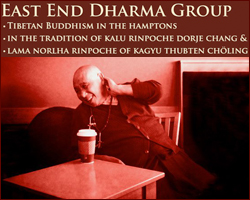 |
East End Dharma Group
Kagyu Lineage Tibetan Buddhism In The Hamptons
East End Dharma Group is a satellite of Kagyu Thubten
Chöling Monastery. EEDG's main function is to act as a
meeting place for practitioners of Tibetan Buddhism who
live on the East End of Long Island.
East End Dharma Group is particularly associated with
the Kagyu Lineage, in the tradition of Kalu Rinpoche
Dorje Chang, and Lama Norlha Rinpoche. EEDG acts as a
place where those interested in Tibetan Buddhism can
meet to practice meditation, and learn about the Dharma.
Currently, East End Dharma Group meets Wednesdays in
Sagaponack, N.Y. for practice of shinay meditation and
recitation of the Chenrezi sadhana. All are welcome. If
you are completely new to Buddhism we can offer basic
meditation instructions as well as general information
regarding books, teachers, and so on.
With our Daily Dharma [Buddhist] Quotes we endeavor to
act as a signpost for those interested in Tibetan
Buddhism on the East End. We can help direct you to well
respected Dharma teachers, teachings, books, and
centers, as well as offer you a wealth of information
regarding upcoming Dharma events in the NY area. East
End Dharma Group strongly supports His Holiness The 14th
Dalai Lama and His Holiness The 17th Gyalwang Karmapa.
Recommended donation per meditation session in Sagaponack is $5.00-$10.00 but is by no means mandatory.
The money does not go to East End Dharma Group, but to
the gracious owner of the building where we hold our
weekly practice sessions.
East End Dharma Group
Kagyu Lineage Tibetan Buddhism In The Hamptons
http://www.eastendharma.com/ |
 |
|
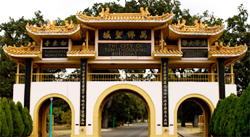 |
Dharma
Realm Buddhist Association (DRBA)
The Dharma Realm Buddhist Association (DRBA), formerly known as the
Sino-American Buddhist Association, was founded by the
Venerable Master Hsuan Hua in 1959. It was established
as a state and federally approved non-profit religious
and educational corporation for the purpose of bringing
the orthodox teachings of the Buddha to the entire
world. The Venerable Master's vision was as vast as the
Dharma Realm, and he taught and transformed all beings
without regard to path of rebirth, country, ethnic
origin, gender and religion.
Dharma Realm Buddhist Association
www.drba.org |
|
|
|
|
Dharma
Realm Buddhist University
Dharma Realm Buddhist University was founded in 1976
with the vision of laying a foundation for the Buddha's
teachings on Western soil.
The Mission of Dharma Realm Buddhist University is to
educate individuals who exemplify excellence in
scholarship and excellence of character, who are aware
of their individual and civic responsibility as world
citizens, and who understand and appreciate a diversity
of cultural traditions. The University community is
dedicated to fostering a spirit of shared inquiry and
the free exchange of ideas that encourages students to
utilize skills of communication, critical analysis,
synthesis, quantification, aesthetic perception, and
creativity along with the intuitive, experiential, and
contemplative dimensions of learning that are the
hallmarks of an educated person.
Further, DRBU seeks to cultivate those aspects of
character consistent with the values and ideals of the
Buddhist tradition in which it is rooted:
self-discovery, personal virtue, compassionate service
to humanity, and sincerity in all endeavors.
Dharma Realm Buddhist University
City of Ten Thousand Buddhas
P.O. Box 217
2001 Talmage Road
Talmage, CA 95481-0217
t 707-462-5486
www.drbu.org |
|
|
|
|
Dipamkara Meditation Center
Dipamkara Meditation Center for Buddhism on Long Island,
New York. Meditation courses and Buddhism on Long
Island, New York. Dipamkara Meditation Center organises
weekly meditation classes at 8 venues on Long Island,
weekend courses and meditation retreats suitable for all
levels of experience. Buddhism Long Island, meditation
Long Island, Buddhism New York, meditation New York.
Dipamkara Meditation Center
282 New York Avenue
P.O. Box 542
Huntington, NY 11743
t 631-692-9594
www.dipamkara.org
www.meditationonlongisland.org |
|
|
|
|
Long
Island Zen Center
An organization of
practitioners of engaged Buddhism dedicated to bringing spirituality
into everyday life through the teachings of the Buddha to benefit
members of our community (Sangha) and the broader community of Long
Island. In Zen Buddhism practice is essential. What you learn in
Buddhism must be your own experience. It cannot be
learned by reading or thinking. You must get beyond your
personal self. What self then appears? You must find
out. Who is then the one who finds out? Only by
dissolving the self can a new self come into being who
finds this out.
Long
Island Zen Center
6 Brewster Court
Setauket, NY 11733
t 631-751-8408
http://zenli-genshin.blogspot.com/ |
|
|
|
|
Vajiradhammapadip
Temple
Vajiradhammapadip Temple is a
Buddhist temple offering international meditation
and Dharma workshops and meditation service located in Centereach,
Long Island.
Vajiradhammapadip Temple
110 Rustic Road
Centereach, NY 11720
t 631-471-8006
http://www.vajira.org/ |
|
|
|
|
Buddhist Society for Compassionate Wisdom (BSCW)
Buddhist Society for Compassionate Wisdom (BSCW) is a
North American Buddhist Order. The Society was founded
in the summer of 1967 as the Zen Lotus Society by
Venerable Samu Sunim at his flat in Manhattan, New York
City. (See Stories) In 1990 the name of the Society was
changed from Zen Lotus Society to Buddhist Society for
Compassionate Wisdom. The change of name reflected an
important development in the movement of the Society.
The experience of more than twenty years of Son-Zen
Lotus Society paved the way for making the necessary
transition from Asian forms of monastic Buddhism to
salvation and enlightenment for all. On the surface this
transition was the modern-day renewal and reapplication
of the five major pronouncement of Mahayana teachings:
1. All sentient beings are Buddhas
2. Samsara is Nirvana
3. One's passions are enlightenment
4. We are an interrelated whole
5. Everyday life is the way
Buddhist Society for Compassionate Wisdom (BSCW)
www.zenbuddhisttemple.org |
|
|
|
|
Buddhist Temples
Buddhist Temples India,
Buddhist Pilgrimage in India, Buddhism Origin, Buddhism
Religion, Buddhist Temple Tours, Buddhist Pilgrimage
Travel India, Information on Buddhism.
Buddhist Temples
www.buddhist-temples.com |
|
|
|
|
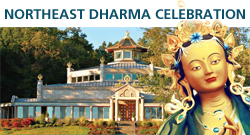
Northeast Dharma Celebration
The Northeast Dharma Celebration gives us an opportunity
to enjoy a wonderful weekend in a beautiful and
inspiring environment, receiving and practicing Buddha’s
teachings in the company of spiritual friends. New
Kadampa Tradition Centers from Maine to Maryland are
joining together to host this annual Northeast Dharma
Celebration in the Kadampa World Peace Temple, just two
hours outside New York. Everyone, whether new to
Buddhism or more experienced, can enjoy and benefit from
this special occasion. Please join us at The Pathway to
the Pure Land, with Gen-la Kelsang Dekyong.
Northeast Dharma Celebration
www.nedharmacelebration.org |
|
|
|
|
Kadampa Buddhism
The New Kadampa Tradition (NKT) - International Kadampa
Buddhist Union
Founder: Venerable Geshe Kelsang Gyatso
Kadampa Buddhism is an international Buddhist tradition,
presenting pure and authentic teachings in a manner
suitable for the modern world. The New Kadampa Tradition
- International Kadampa Buddhist Union (NKT-IKBU) is a
union of Kadampa Buddhist Centres that follow the pure
tradition of Mahayana Buddhism derived from the Buddhist
meditators and scholars Atisha and Je Tsongkhapa,
introduced into the west by the Buddhist teacher
Venerable Geshe Kelsang Gyatso, and that follow the
three New Kadampa Tradition Study Programmes. With over
1000 Kadampa Buddhist centres in over 40 countries
around the world, there are thousands of people now
practising Kadampa Buddhism under the guidance of Geshe
Kelsang Gyatso. The worldwide Kadampa community is like
a global spiritual family, offering support and
encouragement to those wishing to engage in spiritual
practice.
Kadampa Buddhism
www.kadampa.org |
|
|
|
|
Tharpa
Publications International
Publishers of Books on Buddhism & Meditation
- Books and audio books on Buddhism and meditation which
offer something for everyone
- Tharpa books are written by Geshe Kelsang Gyatso, the
fully accomplished meditation master and internationally
renowned teacher of Buddhism
- Tharpa also publishes Buddhist Art and Buddhist
Prayers
All Tharpa profits are donated to the NKT-International
Temples Project, a Nonprofit Buddhist Organization
Building for World Peace.
Tharpa Publications International
www.tharpa.com |
|
|
|
|
Rameshori Buddhist Center
Bringing Peace and Happiness to the Southeast
Buddhism & Meditation For All Levels Of Interest
Rameshori Buddhist Center
130 Allen Road, Unit B
Sandy Springs, Georgia 30328
t 404-255-1585
www.meditationforeveryone.org |
|
|
|
|
Vajravarahi Buddhist Meditation Center
Kadampa Buddhism and Meditation on the East End of Long
Island
Kadampa Buddhism is a Mahayana Buddhist school founded
by the great Indian Buddhist Master Atisha (AD
982-1054). The main practice of a Mahayana Buddhist is
to reduce selfish intention to benefit others. Attisha's
followers are known as 'Kadampas'. 'Ka' means 'word' and
refers directly to Buddha's teachings, and 'dam' refers
to Atisha's special compilations and condensation of
Buddha's Lamrim instructions known as 'the stages of the
path to enlightenment'.The Kadampa tradition was later
made widely known in Tibet by Je Tsongkhapa and his
followers, who came to be known as the 'New Kadampas'.
By integrating our knowledge and understanding of
Buddha's teachings into our everyday lives, and thus
'transforming' our daily activities into our spiritual
path, Kadampa Buddhists use Buddha's Lamrim teachings as
practical methods for transforming daily activities into
the path to freedom and enlightenment.?
Vajravarahi Buddhist Meditation Center
112 Hampton Street
Sag Harbor NY 11963
631-728-5700
www.hamptonsmeditation.org
|
|
|
|
|
The Essentials of Buddhism
The Essentials of Buddhism
www.buddhaweb.org |
|
|
|
|
Long Island Dharma Group
A non-sectarian group of Spiritual
Seekers dedicated to the study of the the Buddha Dharma and meditation
practice. Theravadan,
Zen and other resources.
The
Long Island Dharma Group
|
|
|
|
|
|
|
About Buddhism
Buddhism is often described as a religion and a
collection of various philosophies, based initially on
the teachings of Siddhartha Gautama, known as Gautama
Buddha. To many, however, Buddhism is not a religion,
nor a philosophy or a set of doctrines, but rather
teachings to guide one to directly experiencing reality.
Buddhism is also known as Buddha Dharma or Dhamma, which
means roughly the "teachings of the Awakened One" in
Sanskrit and Pali, languages of ancient Buddhist texts.
Buddhism began around 5th century BCE with the teachings
of Siddhartha Gautama, who was born in what is now Nepal
and taught primarily in northern India, and is hereafter
referred to as "the Buddha." Buddhism is a philosophy
based on the teachings of Lord Buddha (563 BCE-483 BCE),
who was born as Siddhartha Gautama, a Shakya prince in
Lumbini, Nepal. The teachings preached by Lord Buddha
subsequently turned into a religion, known as Buddhism.
The core of Buddhism lies in the purification of mind
and soul by realizing the truth and getting rid of the
worldly desires. Basically, it were the principles of
Karma in the doctrine of Buddhism that made the religion
one of the major ones in the world. |
|
|
|
|
Astrology
|
Baha'ism
|
Buddhism
|
Christianity
|
Confucianism |
Hinduism
|
Humanism
|
Islam
|
Jainism
|
Judaism
|
Shintoism
| Sikhism
|
Taoism
|
Funeral Homes |
|